A Hobby With a Surprisingly Specific Origin Story
Millions of people have picked up a numbered brush and a tiny pot of acrylic paint without ever wondering where the idea came from. Paint by numbers feels like it has always existed — a permanent fixture of craft store shelves and rainy-afternoon hobbies. But it has a real, traceable origin: a specific company, a specific artist, and a specific decade when the whole country seemed to catch the same bug at once. Understanding that paint by numbers history makes the hobby more interesting, and it also explains why the format still works so well today, whether you are filling in a printed canvas or generating one from a personal photo with a modern paint-by-numbers tool.
The Man Behind the Idea: Max S. Klein and the Palmer Paint Company
The paint-by-number fad was initiated by Max S. Klein, the owner of the Palmer Paint Company, together with an artist he employed named Dan Robbins. Klein ran a paint manufacturing business, which meant he already had the raw materials — literal buckets of paint — and a commercial reason to want more people buying and using them. What he needed was a product concept that would turn ordinary consumers, most of whom had never picked up a brush since a school art class, into regular paint customers. That commercial instinct, paired with an artist willing to experiment, is where the hobby as we know it began.
Dan Robbins and the Leonardo da Vinci Connection
Robbins conceived the paint-by-number kit concept in the late 1940s while working at the Palmer Paint Company. According to the account preserved by the Smithsonian's National Museum of American History, his inspiration traced back centuries: the idea that Leonardo da Vinci used numbered background patterns to guide his students and apprentices as they worked on sections of his paintings. Whether or not every apprentice in Renaissance Florence literally worked from numbered outlines, the underlying concept Robbins borrowed was simple and powerful — break a complex image into small, clearly labeled sections, and anyone can reproduce it convincingly, one section at a time, without needing to understand color theory, perspective, or brushwork technique. That is the entire mechanical idea behind paint by numbers, and it has not changed in more than seventy years.
It is worth pausing on why that idea was so radical for a consumer product in the 1940s. Fine art was, and still is, often treated as something you either have a gift for or you do not. Robbins and Klein were selling the opposite message: that anyone, regardless of talent, could produce something that looked like a real painting, hang it on a wall, and feel a genuine sense of accomplishment. That promise — art without the intimidation of art — is arguably the single most important ingredient in the hobby's success, more important than any specific numbering system or paint formula.
1951: The "Craft Master" Launch
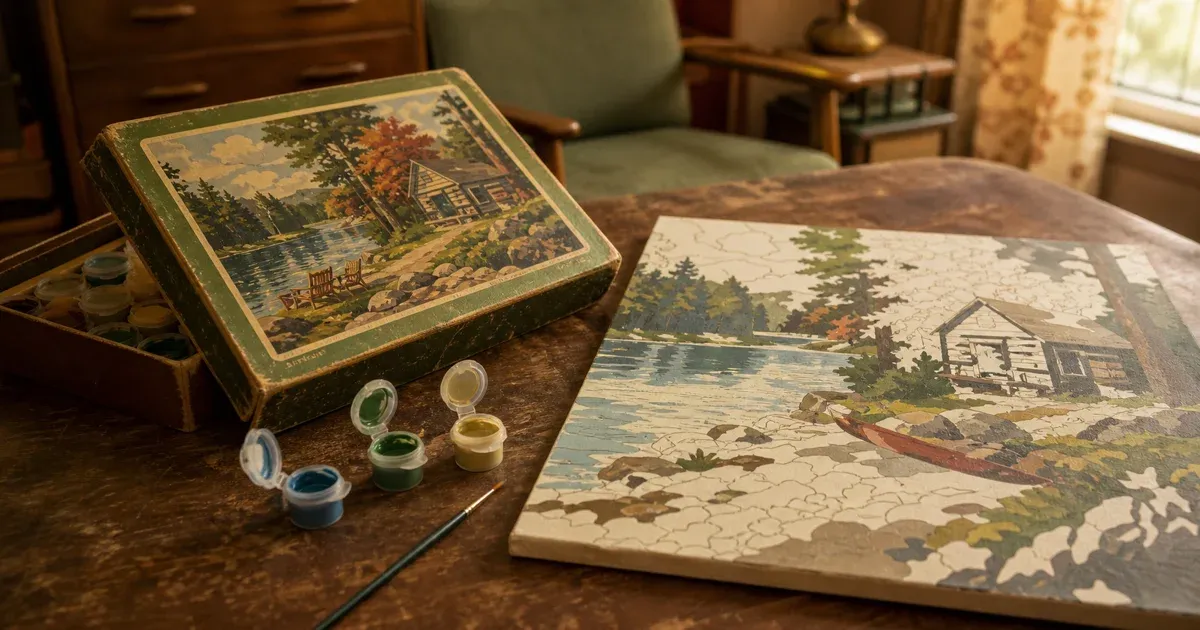
The idea moved from concept to store shelf in 1951, when Palmer Paint began selling the kits under the "Craft Master" brand. This was not a quiet regional release. Craft Master kits were positioned as a genuinely new category of home hobby product, sold alongside other paint and craft supplies, and marketed toward a general audience rather than trained artists. Each kit bundled everything a beginner would need: a printed canvas or canvas board with numbered outlines, a set of small paint pots keyed to those numbers, and brushes sized for detail work. The user did not need to source materials, mix custom colors, or make a single creative decision about composition — every choice had already been made. All that remained was to match number to color and fill in the shape.
That completeness was itself a marketing masterstroke. A customer could walk into a store, buy one box, and walk out with everything required to finish a painting that weekend. There was no separate trip for canvas, no separate trip for paint, and no guesswork about which colors to buy. For a country in the early 1950s that was rapidly expanding its idea of what a "leisure activity" could look like, a self-contained hobby-in-a-box was an easy sell.
By 1954: Twelve Million Kits and a National Craze
The scale of the response was enormous. By 1954, just three years after the Craft Master launch, the company had sold more than 12 million kits. That number is worth sitting with: in the space of a few years, a paint manufacturer's side project had become a genuine mass-market phenomenon, reaching well beyond hobbyists who already thought of themselves as "crafty" people. Paint by numbers became something closer to a shared cultural moment — the kind of product that shows up in family photographs, gets mentioned in period magazines, and ends up as a recognizable shorthand for a particular slice of mid-century American home life.
Part of what made the craze possible was timing. The postwar years brought new suburban homes with blank walls to decorate, more disposable income for hobby spending, and a cultural appetite for structured, family-friendly activities that filled evenings and weekends. Paint by numbers fit neatly into that moment: inexpensive enough for a middle-class household budget, simple enough for a parent and child to do together, and satisfying enough to produce a finished object worth displaying. It did not require any special skill acquired over years, and it did not require expensive equipment — just the box itself.
Critics, Skeptics, and the "Is It Really Art?" Debate
Not everyone embraced the trend warmly. Then, as now, there was a strain of criticism holding that painting by numbers was not "real" art — that following a pre-drawn outline and a paint-by-color key removed the creative judgment that supposedly defines painting as an art form rather than a craft. That tension between the mass-market, accessible version of art-making and the more traditional, skill-gated version never fully resolved, and in some ways it is the same tension that surrounds many accessible creative tools today, digital or otherwise. What the debate tends to miss, though, is that most people who bought a Craft Master kit in 1952 were never going to take formal painting lessons regardless. The kit did not replace a fine-art education people were on the verge of pursuing; it created an entry point into painting for people who would otherwise never have picked up a brush at all.
The Smithsonian Recognizes the Craze
The cultural significance of the fad was formally recognized decades later. In 2001, the Smithsonian's National Museum of American History mounted an exhibition titled "Paint by Number: Accounting for Taste in the 1950s," curated by William L. Bird. The exhibition treated paint-by-number kits not as a footnote in craft history but as a genuine artifact of American consumer culture — evidence of how a manufacturer, a marketing strategy, and a well-timed cultural mood could combine to reshape how ordinary families spent their evenings and decorated their homes. Having a national museum devote a dedicated exhibition to the phenomenon says something about how deeply the craze had embedded itself in the broader story of mid-century American life, well beyond the hobby aisle. It also cemented the historical record: Klein's business instinct, Robbins' da Vinci-inspired concept, and the "Craft Master" brand as the recognized origin point of the format that is still recognizable in every paint-by-numbers kit sold today.
What Made the Format Endure
Plenty of 1950s fads faded along with the decade. Paint by numbers did not. The format has been through waves of revival, nostalgia, and reinvention over the following seventy-plus years, and the core mechanic Robbins landed on in the late 1940s — numbered regions matched to a fixed color key — has never needed to change. A few things explain that durability. It scales down to a small, forgiving amount of skill required while still producing a recognizable, satisfying result. It works as a solo hobby or a shared one. It is genuinely relaxing in a way that has aged well across very different generations of leisure culture, from postwar suburbia to today's interest in mindful, screen-light hobbies. And critically, it never depended on any single company or product: once the underlying idea was public, the format could be reproduced by any manufacturer, in any subject matter, at any price point.
Why the Simplicity Worked: Guided Creativity as a Psychological Trick
It is tempting to describe paint by numbers as a shortcut, but that undersells what is actually happening when someone fills in a numbered region. The activity still requires steady hands, patience, and attention to detail — the physical and meditative parts of painting are fully intact. What the numbering system removes is the part that intimidates most beginners: the blank canvas problem. Deciding what to paint, how to compose it, and which colors belong where is, for most people, the hardest part of making art, harder than the actual brushwork. Robbins' numbered-region system quietly answers all three questions before the painter picks up a brush, which frees them to focus entirely on the physically satisfying, repetitive act of applying paint neatly inside a boundary. That is a genuinely different activity from unstructured painting, but it produces a very similar emotional payoff: a finished object you made with your own hands.
This is also why the format translated so easily across generations that otherwise have very little in common in how they spend their leisure time. A 1950s suburban parent filling in a lakeside cabin scene after dinner and someone today generating a template from a phone photo and painting it while listening to a podcast are doing functionally the same activity, for many of the same reasons: a low-pressure, screen-adjacent-but-not-screen-dependent way to make something tangible.
From Printed Kits to Personal Photos: The Digital Evolution
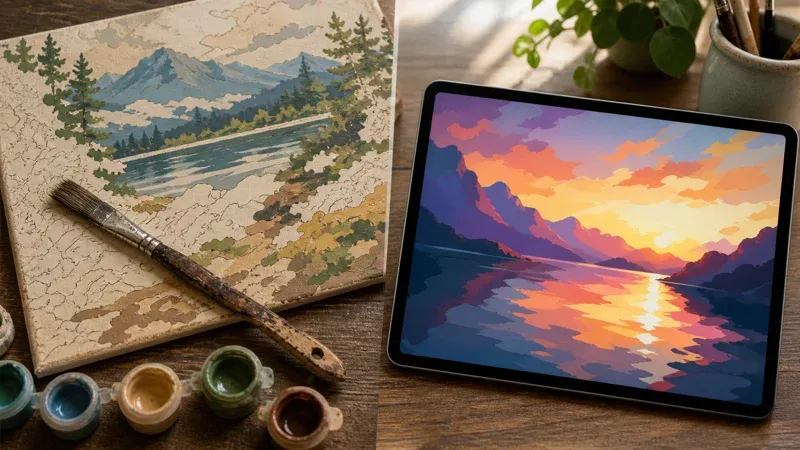
What has genuinely changed since 1951 is not the core idea but the source material. A Craft Master kit offered you a fixed catalog of pre-drawn scenes — a cabin by a lake, a bowl of fruit, a country church. You painted whatever the box contained. Today's digital paint-by-numbers generators flip that constraint entirely: instead of choosing from a printed catalog, you can turn any photo you own — a family portrait, a pet, a childhood snapshot — into a numbered template built specifically from that image.
The mechanism behind that shift is a modern application of an old idea in image processing called color quantization: reducing a photograph's effectively unlimited range of colors down to a small, fixed palette, the same basic problem Robbins solved by hand with a paintbrush and a printed outline, now solved computationally in seconds. Our companion article on how paint-by-numbers generators work walks through exactly how that process runs today, including how color clustering picks a palette suited to your specific photo. If you want to try it yourself with a photo you already have, our step-by-step walkthrough on how to turn a photo into a paint-by-numbers canvas covers the whole process from upload to a printable template.
In a real sense, a free browser-based generator is the most direct descendant of what Klein and Robbins were trying to do in 1951: remove every barrier between an ordinary person and a finished painting they can be proud of. The tools changed. The goal never did.
Conclusion
Paint by numbers began as a specific commercial idea from Max S. Klein and Dan Robbins at the Palmer Paint Company, inspired by a story about Leonardo da Vinci's numbered guides for apprentices, and launched to the public in 1951 under the "Craft Master" brand. Within three years it had sold more than 12 million kits and become a defining artifact of 1950s American leisure culture, significant enough to earn its own Smithsonian exhibition decades later. The specific format — numbered regions, a matching color key, zero required skill — turned out to be durable enough to survive changing tastes, changing decades, and a complete shift from printed catalogs to personal photographs converted by algorithms. Try the modern version of that seventy-year-old idea with the free Paint by Numbers Generator.
References and Further Reading
- Paint by Number: Accounting for Taste in the 1950s — the Smithsonian National Museum of American History's 2001 exhibition record, curator William L. Bird, source for the Klein/Robbins origin story, the da Vinci inspiration, the 1951 Craft Master launch, and the 12-million-kit sales figure by 1954.
- Thank Dan Robbins for the Paint-by-Number Craze — Smithsonian Magazine's profile of Dan Robbins and the paint-by-number craze he helped launch.
- Color quantization — background on the image-processing technique that modern digital paint-by-numbers generators use to reduce a photo to a fixed color palette.